





VANCOUVER, B.C.—The multifaceted, complex medical problem that is obesity is seeing big advances that are starting to have a major effect on treatment. GI providers now have a growing arsenal of tools and strategies at their disposal to provide targeted, patient-specific care.
From perspectives in patient care to recent breakthroughs in pharmacotherapy, the 2023 annual meeting of the American College of Gastroenterology offered several lectures with insights into the future management of obesity. Here are key takeaways from three of those presentations.
Holistic Patient Evaluation
According to Christopher G. Chapman, MD, the director of bariatric and metabolic endoscopy at Rush University Medical Center, in Chicago, management of chronic obesity requires a comprehensive understanding of the underlying reasons for the disease, which range from societal to structural issues, metabolic factors and age. An initial assessment that considers detailed health and lifestyle history, physical examination including body mass index measurements and lab tests, and other diagnostic testing relevant to the patient’s conditions are necessary before initiating treatment, Dr. Chapman said. This process also should encompass an understanding of the patient’s mental health status, which could significantly affect the choice of therapy.
“In essence, a holistic understanding of your patient’s life and health profiles is foundational to obesity management’s four key components recommended by the Obesity Medicine Association: nutritional therapy, physical activity, behavioral modification and therapy,” Dr. Chapman said.
Pharmacotherapy Breakthroughs
The effectiveness of obesity pharmaceutical treatment has historically been “less than exciting,” Dr. Chapman said, with previously FDA-approved medications delivering an average weight loss of less than 10% of total body weight. However, there has been a recent paradigm shift with the introduction of new pharmaceutical agents producing “previously unimaginable results.”
Semaglutide (Ozempic/Wegovy, Novo Nordisk), an FDA-approved, injectable glucagon-like peptide-1 (GLP-1) agonist, has demonstrated an average weight reduction of 15% in recent clinical trials (N Engl J Med 2021;384[11]:989-1002). The increased efficacy can be attributed to the drug’s synthesized peptide structure, which avoids degradation and results in a longer half-life.
With semaglutide, “patients can essentially achieve lower total body weight and maintain it for up to two years while on therapy,” Dr. Chapman said. “This drug has set an outstanding precedent in the field of pharmacotherapy for obesity.”
Several additional pharmacologic options have shown efficacy in this setting. For example, tirzepatide (Mounjaro/Zepbound, Lilly), a single synthetic peptide that stimulates both GLP-1 and gastric inhibitory polypeptide (GIP) receptors, has demonstrated weight reduction averaging 20% to 25% in ongoing global phase 3 trials (N Engl J Med 2022;387[3]:205-216).
Besides these injectable medications, the scientific community also is working on developing oral GLP-1 agonists to offer alternatives for patients who might not want injections, Dr. Chapman said, noting that various oral medications and synthetic peptide–based drugs are undergoing trials, showing significant weight loss potential.

GLP-1 Agonists and Side Effects
Although GLP-1 agonists have proven to be effective in managing conditions like diabetes and obesity, their impact on GI motility and associated side effects needs to be considered. According to Baha Moshiree, MD, MSc, FACG, the director of motility at Atrium Health and Wake Forest Medical University, in Charlotte, N.C., a chief area of concern about GLP-1 agonists has been their inhibition of gastric emptying.
“Research has found that the administration of the GLP-1 agonist liraglutide [Victoza/Saxenda, Novo Nordisk] delayed gastric emptying,” Dr. Moshiree said. “At the five-week mark, the median delay was approximately 70 minutes, but this decreased to 30 minutes after 16 weeks.”
“This impact on gastric emptying raises several questions, such as whether all diabetic patients or patients who are prescribed these drugs should undergo a gastric emptying study or whether the delay in gastric emptying improves with a longer duration of therapy,” Dr. Moshiree added.
Besides delayed gastric emptying, nausea and vomiting have been a common cause of discontinuation of these drugs in more than 50% of patients. However, multiple studies conducted on the effects of GLP-1 have shown that these side effects generally occur at the start of treatment and decrease as the body gets used to the medication.
According to Dr. Moshiree, patients on these drugs need to be managed with an individualized approach—achieving a dose with minimal possible GI side effects and maximum weight loss. Strategies can include starting at a lower dose and then slowly increasing it over time as well as switching to different treatment methods for more severe cases. It’s also essential to provide education and ongoing support to manage possible side effects, Dr. Moshiree stressed.
Combining Endobariatrics And Pharmacotherapy
Advancements in endoscopic bariatric therapies are another promising avenue for weight loss treatment. According to Shelby Sullivan, MD, the director of the Gastroenterology Metabolic and Bariatric Program at the University of Colorado, in Denver, these therapies can be used when patients fail to achieve desired results from standard approaches like dietary interventions, exercise and pharmacotherapy.
“There are solid data supporting combination therapy with anti-obesity medications and endoscopic metabolic bariatric therapies, but the decision depends on various factors,” Dr. Sullivan said. “This includes the device used, the patient’s willingness to take the medication long term, treating another condition and unsuccessful weight loss after procedures.”
Dr. Sullivan underscored the importance of compliance with pharmacotherapy protocols because the adherence of patients to anti-obesity medications remains low. In a study that included nearly 27,000 patients, only about 36% of patients started on liraglutide were still taking it at 12 months (Diabetes Res Clin Pract 2018;143:348-356).
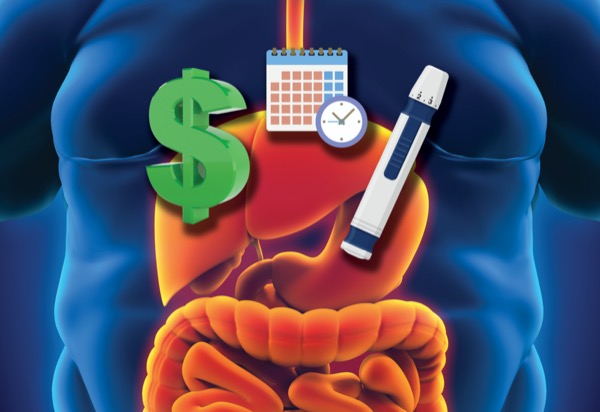
There’s also the issue of cost. Despite the known benefits of weight loss for conditions including cardiovascular disease, Dr. Sullivan said, the cost of these medications does not decrease the cost of caring for the patient. In fact, it significantly increases it. According to a real-world analysis of GLP-1 receptor antagonists by the pharmacy benefit management companies Prime Therapeutics and Magellan Rx Management, for example, the annual cost per patient rose dramatically to nearly $26,000 for those who took the medication for the entire year.
“Newer anti-obesity medications, while effective, are costly and lack long-term adherence by patients,” Dr. Sullivan said. “A comprehensive approach addressing all these considerations should guide weight loss therapy for obesity cases.”
—Chase Doyle
Drs. Chapman, Moshiree and Sullivan reported no relevant financial disclosures.
This article is from the January 2024 print issue.