





WASHINGTON—A stool-based test that combines three sources of biomarkers of colorectal cancer—mRNA, DNA and hemoglobin—using an artificial intelligence/machine learning–driven algorithm showed high sensitivity for advanced adenomas and other cancer precursors. The presentation detailing the findings drew considerable attention at DDW 2024 (abstract Su1117).
The primary advantage of the multimodal stool nucleic acid (mm-sNA) test (ColoAlert, Mainz Biomed) “is the combined use of these biomarkers and the use of the artificial intelligence/machine learning–based algorithm [AI/ML],” investigator Lena Krammes, PhD, a senior scientist with Mainz BioMed, told Gastroenterology & Endoscopy News. The test is “highly sensitive for both advanced adenomas and early-stage cancer,” with a sensitivity and a specificity of 97% for CRC and 82% and 97%, respectively, for advanced precancerous lesions (APLs), she reported.
High Sensitivity for APLs
The test applies an AI/ML algorithm to classic fecal immunochemical testing (FIT) and identifies novel nucleic acid markers derived from mRNA and DNA. The test was studied in 333 adults (31% aged 60-69 years) enrolled from 21 U.S. sites. Of 254 evaluable participants, 103 served as controls; 35 were found to have CRC, 65 had advanced adenomas and 51 had nonadvanced adenomas.
The combined use of the advanced nucleic acid markers and FIT performed well regardless of lesion type (Table 1), and the sensitivity for APLs, by subtype, was much greater that that reported in published studies of the other stool-based screening tests (N Engl J Med 2024;390[11]:984-993; JAMA 2023;330[18]:1760-1768; N Engl J Med 2024;390[11]:973-983) (Table 2).
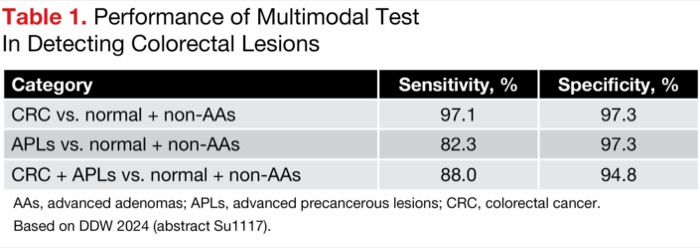
| Table 1. Performance of Multimodal Test In Detecting Colorectal Lesions | ||
| Category | Sensitivity, % | Specificity, % |
|---|---|---|
| CRC vs. normal + non-AAs | 97.1 | 97.3 |
| APLs vs. normal + non-AAs | 82.3 | 97.3 |
| CRC + APLs vs. normal + non-AAs | 88.0 | 94.8 |
| AAs, advanced adenomas; APLs, advanced precancerous lesions; CRC, colorectal cancer. Based on DDW 2024 (abstract Su1117). | ||
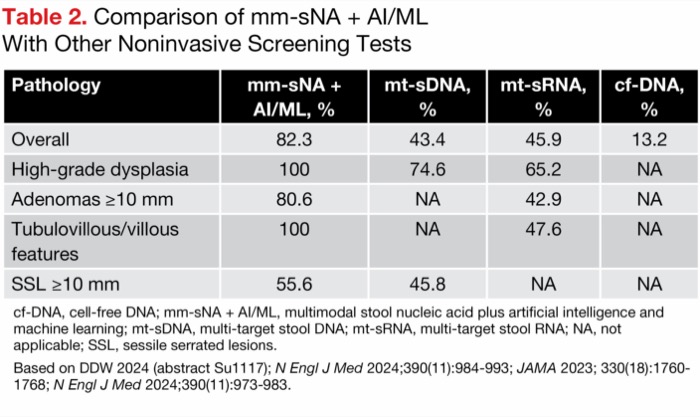
| Table 2. Comparison of mm-sNA + AI/ML With Other Noninvasive Screening Tests | ||||
| Pathology | mm-sNA + AI/ML, % | mt-sDNA, % | mt-sRNA, % | cf-DNA, % |
|---|---|---|---|---|
| Overall | 82.3 | 43.4 | 45.9 | 13.2 |
| High-grade dysplasia | 100 | 74.6 | 65.2 | NA |
| Adenomas =10 mm | 80.6 | NA | 42.9 | NA |
| Tubulovillous/villous features | 100 | NA | 47.6 | NA |
| SSL =10 mm | 55.6 | 45.8 | NA | NA |
| cf-DNA, cell-free DNA; mm-sNA + AI/ML, multimodal stool nucleic acid plus artificial intelligence and machine learning; mt-sDNA, multi-target stool DNA; mt-sRNA, multi-target stool RNA; NA, not applicable; SSL, sessile serrated lesions. Based on DDW 2024 (abstract Su1117); N Engl J Med 2024;390(11):984-993; JAMA 2023; 330(18):1760-1768; N Engl J Med 2024;390(11):973-983. | ||||
In addition, in identifying all stages of CRC, the clinical performance of the mm-sNA + AI/ML test was much better than that achieved with FIT alone. For the new test compared with FIT, the sensitivity was 90.9% versus 55.0% for stage I, 100% versus 89.0% for stage 2, 100% versus 86.0% for stage 3, and 100% (for both) for stage 4.


“Compared to the classic effort, there is a clear improvement, such as a doubling in the detection of stage I cancer,” Dr. Krammes said. “It’s the same with advanced APLs, and it detects the subgroups with high sensitivity.”
Potentially a Simpler Test
Graeme Young, MD, the Matthew Flinders Distinguished Emeritus Professor at Flinders University in Wheelers Hills, Australia, told Gastroenterology & Endoscopy News that a test that examines molecular markers and hemoglobin is appealing. “It’s improving our ability to use a noninvasive test to screen for colorectal cancer. It’s probably going to have better accuracy than hemoglobin alone,” he said.
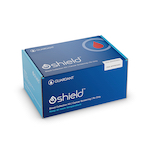

“But the particularly interesting thing about this test is that the stool is sampled with a tube that is no different than the FIT test—the stool sample is small—whereas the current most well-proven molecular test, the multi-target stool DNA test, requires the whole stool,” Dr. Young said.
Commenting on the observed higher sensitivity for advanced adenomas, he cautioned, “This study is very early, and early [studies] are usually biased toward getting a better result.” In contrast, the multitarget stool DNA test (Cologuard, Exact Sciences) “has been tested in huge populations in a screening environment,” he said, adding, “we need a lot more clinical data” for this new test.
—Caroline Helwick
Dr. Krammes reported that she is employed by and is a shareholder of Mainz Biomed Germany GmbH. Dr. Young reported financial relationships with Clinical Genomics and Health First Systems.
This article is from the January 2025 print issue.