





Patients with stage II or III colon cancer who have not experienced a recurrence within six years after surgery and adjuvant chemotherapy have a 0.5% or less risk for recurrence and can be considered cured, according to the findings of a large pooled analysis (JAMA Oncol 2025 Oct 2. doi:10.1001/jamaoncol.2025.3760). The results are significant in terms of tailoring surveillance and soothing concerned patients.
“When a patient develops cancer, even when they are in a curable stage, they still worry that they may develop recurrence. But there is a certain threshold beyond which a cancer patient is defined as cured: They do not have an increased risk of developing recurrence beyond the general population,” said Sameh Hany Emile Rizkalla, MD, a project scientist at Cleveland Clinic Florida, in Weston, and an associate professor of colorectal and general surgery at Mansoura University, in Egypt. Dr. Rizkalla was not involved in the study.
Due to the confounders of secondary cancer and death, the definition of cure in stage II/III colon cancer has been ambiguous. To adjust for these confounders, the investigators took them into account as competing risks. Their analysis included 15 phase 3 randomized controlled trials (RCTs) with 35,213 patients, all of whom underwent radical surgery and adjuvant chemotherapy for their disease, with a median follow-up of at least six years.
“They wanted to determine when the risk of recurrence of colon cancer becomes negligible and used a predefined threshold of 0.5%, which I completely agree with,” Dr. Rizkalla said. The challenge was to find the point at which patients reach that 0.5% risk threshold.
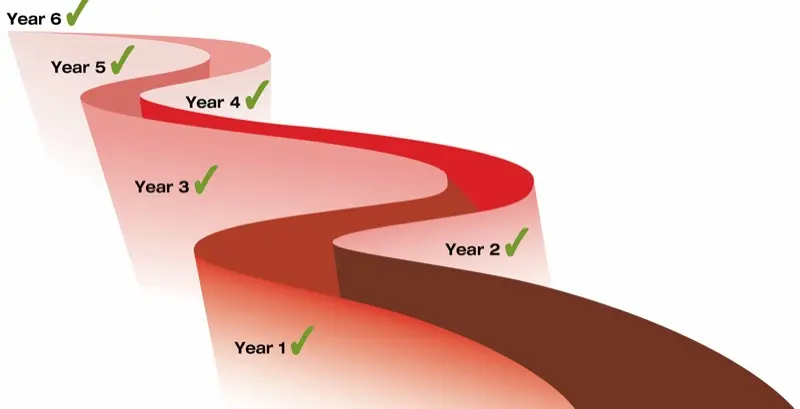
Not surprisingly, the highest rate of recurrence was within the first year after surgical and chemotherapy, when recurrence peaked at 6.4%. From that point on, recurrence rates dwindled until 10 years’ follow-up, with the 0.5% rate achieved at six years.
There was an increase in recurrence rate after 12 to 13 years, reaching 2%, but this pattern was seen only in the MOSAIC trial (N Engl J Med 2004;350[23]:2343-2351).
“Keep in mind that was exclusively attributable only to the MOSAIC trial, a single trial, and this was a group analysis of 15 RCTs. So, the findings of a single trial should not deviate us from the main finding,” Dr. Rizkalla said.
“This means that when a patient has reached six years after surgery and chemotherapy without developing a recurrence, we can tell them, ‘You’re cured, and there is no need for further surveillance’” beyond guideline recommendations, Dr. Rizkalla said.
This finding is of twofold importance, he continued. First, it’s practical. “We tailor our surveillance. Instead of continuing long-term surveillance, which may be unnecessary, … we can adjust surveillance to be as short as possible, assured that we have reached a cure end point.” Second, it could have an important psychological impact on patients “when you can tell them that when they hit the six-year benchmark, they’re cured.”
But he cautioned that the data apply only to patients treated for stage II/III colon cancer. “For stage I or IV or for rectal cancer or another type of GI cancer, this end point might be different, and I would expect it to be,” Dr. Rizkalla said.
David Johnson, MD, a professor of medicine and the chief of gastroenterology at Eastern Virginia Medical School/Macon & Joan Brock Virginia Health Sciences at Old Dominion University, in Norfolk, said the data were encouraging for improvements in colon cancer survival, and that it’s important to understand follow-up from both an oncologic and gastroenterologic perspective.
First, all patients in the study followed recommendations for repeat imaging, typically CT or MRI, every six to 12 months for five years. “This imaging would look for extraluminal disease, given the invasive nature of stage II/III colon cancer. By national guidelines, however, the recommendation would be repeat colonoscopy one year after surgery, unless a quality exam of the colon proximal to the tumor is not possible prior to surgery, in which case, it should be done three to six months after treatment; if normal, repeat at three years and, if continued normal, repeat every five years.
“If adenomas or advanced lesions are found, the intervals should be adjusted appropriately. These most recent data should not change these guideline recommendations for colonoscopy follow-up,” Dr. Johnson told Gastroenterology & Endoscopy News.
Screening colonoscopy, he pointed out, has been shown to be the best test for prevention of CRC. “It’s important to recognize that the success of screening and surveillance exams, as identified by data and national guideline consensus, are significantly linked to a high-quality exam performed by a high-quality colonoscopist,” he said. “These reported improvements [in] treatment are encouraging, but our key focus should be on identified quality measures for both primary and secondary prevention.”
—Monica J. Smith
Drs. Johnson and Rizkalla reported no relevant financial disclosures.

This article is from the December 2025 print issue.