





Related Content
WASHINGTON—Universal application of cold snare endoscopic mucosal resection for all large colorectal polyps resulted in no significant safety benefits over hot snare EMR during a recent multicenter randomized trial. The investigators found that although cold EMR completed as intended can be safer than hot snare EMR, the former is associated with a higher recurrence rate.
“The up-front safety benefit [of cold snare EMR] is diminished by a high recurrence rate after cold resection, far greater than after hot resection,” reported investigator Heiko Pohl, MD, a professor of medicine at Dartmouth Geisel School of Medicine, in Hanover, N.H. “But we also were surprised to see a fairly high recurrence rate after hot EMR, which is in contrast to recent studies that included margin ablation,” Dr. Pohl said, presenting the findings at DDW 2024 (abstract Sp1251).
Clarifying the Role of Cold EMR
The study compared the safety and efficacy of cold versus hot EMR in 660 patients treated at 15 centers for nonpedunculated colorectal polyps measuring at least 20 mm. The protocol included margin ablation of all polyps and clip closure of proximal polyps after hot EMR. The study’s primary outcome was the rate of severe adverse events within 30 days. The secondary outcome was recurrence rate of polyps at six months.
Severe adverse events occurred in 4.3% of the hot snare group and 2.1% of the cold snare group, a difference that was not statistically significant in the intention-to-treat analysis (P=0.10). However, in the per-protocol analysis, where polyps were resected as planned, these rates were 4.9% for hot snare versus 1.4% for cold snare, showing a statistically significant risk reduction of 71% with cold snare (P=0.017).
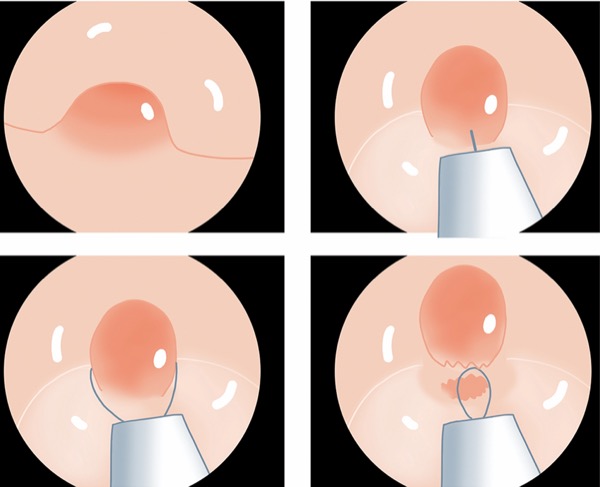
Recurrence rates at six months differed between the groups, with recurrences observed in 14% of the hot snare group and 28% of the cold snare group in the intention-to-treat analysis (P<0.001), and in 12% and 29%, respectively, in the per-protocol analysis (P<0.001).
Dr. Pohl noted that there was a “surprisingly high rate of crossover” in the study: 15% in the cold EMR group and 13% of the hot EMR group.
Future Studies Needed To Refine Patient Selection
Based on these findings, Dr. Pohl told Gastroenterology & Endoscopy News that universal application of cold EMR for any nonpedunculated polyps measuring at least 20 mm is not justified. “Cold EMR may be beneficial for a subset of polyps (i.e., sessile serrated polyps, polyps <30 mm), or in select patients for whom an up-front safety benefit is important/relevant and who would not mind having an additional colonoscopy for recurrence,” he said.
More data are needed on the role of cold EMR for lesions larger than 20 mm in size, but lower risk lesions may be acceptable, such as flat adenomas with a homogenous surface, noted John Guardiola, MD, an assistant professor of clinical medicine at Indiana University, in Indianapolis. “Those tend to have less fibrosis,” he said. “Anything that’s bulky and has a lot of fibrosis is not going to be good for cold EMR and would likely need electrocautery,” Dr. Guardiola told Gastroenterology & Endoscopy News.
Dr. Pohl said he hopes future studies will focus on refining cold EMR techniques and identifying those subsets of patients whose polyps could be effectively be removed by cold EMR.
Kenneth F. Binmoeller, MD, the director of interventional endoscopy services at the California Pacific Medical Center, in San Francisco, and founder and president of Endovision Foundation, a nonprofit that fosters physician-driven device innovation, said the study’s results echo those of the German CHRONICLE trial published earlier this year (Gastroenterology 2024 May 23. doi:10.1053/j.gastro.2024.05.013).
“Cold resection of polyps greater than 1 cm requires what I call an ‘ultra-piecemeal’ technique. This is due to the amount of tissue that can be transected by mechanical force alone. We know that piecemeal resection increases the risk of recurrence. Thus, it is not surprising that ultra-piecemeal resection by cold snaring was found to significantly increase the recurrence rate,” he said.
“Regardless of the technique used, the goal should be en bloc resection whenever possible,” Dr. Binmoeller added. “With cold snaring, even small polyps less than 1 cm may fail en bloc resection, depending on how much surrounding tissue is captured. Ideally, we want documentation of R0 resection, that is, clear vertical and horizontal margins, after polypectomy.”
—Caroline Helwick
Dr. Binmoeller reported that he holds over 50 patents for novel endoscopic technologies and has founded several startup companies developing endoscopic devices. Drs. Guardiola and Pohl reported no relevant financial disclosures.
This article is from the August 2024 print issue.