






In this issue of Sharma’s Endoscopy Insights, I discuss three studies with ranging topics: colon polyps with submucosal invasion, resection using cold snare polypectomy versus cold endoscopic mucosal resection, and a through-the-scope suturing system.
The ability of the endoscopist to recognize submucosal invasion in large (=20 mm) nonpedunculated polyps is important since it affects endoscopic treatment. In a large study of such patients, investigators showed that submucosal invasion was associated with several findings: depressed lesions, polyps in the rectosigmoid colon, polyps with a granular-type morphology and polyps increased in size.
Both cold snare polypectomy (CSP) and cold EMR (C-EMR) have been used for the removal of nonpedunculated colorectal colon polyps. I discuss a systematic review comparing rates of complete resection and adverse events associated with these two techniques.
Endoscopic closure of gastrointestinal defects using closure devices is extremely important for multiple advanced endoscopic resection techniques and third-space endoscopy. A novel through-the-scope helix stack suture system was tested and reported in the third study I highlight.
Predicting Submucosal Invasion
Endoscopy 2024 April 29. doi:10.1055/a-2282-4794
In Australia, researchers developed a decision-making algorithm to help providers identify submucosal invasive cancer (SMIC) in large nonpedunculated colonic polyps (LNPCPs) at least 20 mm in size and thought to be benign.
The analysis included 2,260 patients referred for LNPCP resection at a tertiary referral center between September 2008 and November 2022. Evaluating endoscopic resection specimens, lesion biopsies and surgical outcomes, the researchers analyzed 2,451 LNPCPs. The analysis included only adenomatous LNPCPs and excluded serrated lesions.

SMIC, which was confirmed in 273 LNPCPs (11.1%), was associated with depressed and nodular versus flat morphology (odds ratio, 35.7; 95% CI, 22.6-56.5 and 3.5; 95% CI, 2.6-4.9, respectively; P<0.001), rectosigmoid versus proximal location (OR, 3.2; 95% CI 2.5-4.1; P<0.001), nongranular (NG) versus granular subtype (OR, 2.4; 95% CI, 1.9-3.1; P<0.001) and increased size (OR, 1.12 per 10-mm increase; 95% CI, 1.05-1.19; P<0.001).
The analysis indicated SMIC prevalence was 62% in depressed LNPCPs, 19% in nodular rectosigmoid LNPCPs and 20% in nodular proximal colon NG-LNPCPs. The lowest prevalence of SMIC was in flat, proximal colon, granular LNPCPs.
For nodular lesions, the location of those lesions can help providers determine the risk for cancer; in the proximal colon, nodular NG-LNPCPs have a high probability of SMIC (20%), whereas nodular, granular LNPCPs have a low probability (5%).
The researchers concluded that their algorithm, combined with review of the surface of the lesion, can help providers accurately identify the type of LNPCP and evaluate their resection choices. However, they acknowledged that the algorithm still needs to undergo external validation.
Cold Resection
Endoscopy 2024 Mar 19. doi:10.1055/a-2275-5349
Researchers in Brazil performed a systematic review of seven randomized controlled trials comparing C-EMR and CSP.
The analyzed studies included data from 1,556 patients and 2,287 colorectal polyps measuring 20 mm or smaller; 51.4% of the lesions were removed with C-EMR and 48.5% with CSP. The primary outcome was complete resection, and the secondary outcomes were procedure time, adverse events and en bloc resection.

In the analysis, the researchers found C-EMR and CSP had similar risk ratios for complete resection (RR, 1.02; 95% CI, 0.98-1.07), adverse events (RR, 0.74; 95% CI, 0.41-1.32) and en bloc resection (RR, 1.08; 95% CI, 0.82-1.41).
But C-EMR had a longer procedure time, at 128.5 seconds (95% CI, 86.6-170.3 seconds) compared with 85.6 seconds for CSP (95% CI, 38.8-132.3 seconds) (mean difference, 42.1 seconds; 95% CI, 14.5-69.7 seconds).
The two procedures have similar safety profiles and efficacy, but C-EMR takes significantly longer, reported the researchers, noting that this could be due to the additional time required to perform the submucosal injection during C-EMR.
Through-the-Scope Tack and Suture
Endoscopy 2024 Mar 22. doi:10.1055/a-2284-7334
In this study, researchers in the United States conducted a meta-analysis of studies examining how effective the through-the-scope helix track suture system (TTSS) is in closing large irregular defects. The researchers analyzed eight studies that included 448 patients. The mean defect size was 34.3 mm.
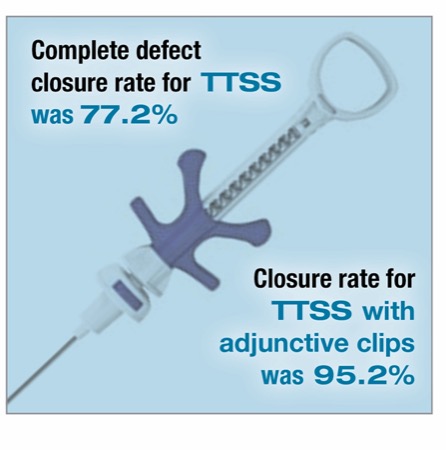
The researchers found the complete defect closure rate for TTSS was 77.2% (95% CI, 66.4%-85.3%; I2=79%), and the closure rate for TTSS with adjunctive clips was 95.2% (95% CI, 90.3%-97.7%; I2=42.5%).
They also found the complete defect closure rate was 99.2% (95% CI, 94.3%-99.9%; I2=0%) with TTSS during EMR and 92.1% (95% CI, 85%-96%; I2=0%) with TTSS during endoscopic submucosal dissection.
The rate of adverse events was 5.4% (95% CI, 2.7%-10.3%; I2=55%). There were no adverse events from the device itself in the studies examined.
Although TTSS has an acceptable safety profile and a high technical and clinical success rate, it is prone to suture breakage, the researchers noted, and the studies included in the analysis found two technical failures with the device.
Further research is needed to determine the optimal situations in which to deploy TTSS as well as to determine the cost-effectiveness of using TTSS.
Dr. Sharma is a member of the Gastroenterology & Endoscopy News editorial board.


This article is from the May 2024 print issue.