





Section Editor
Virginia Tech Carilion School of Medicine
Roanoke, Virginia
Universidad de La Rep=blica
Montevideo, Uruguay
Contributors
Division of Digestive Diseases and Nutrition
University of South Florida
Tampa, Florida
University of South Florida
Tampa, Florida
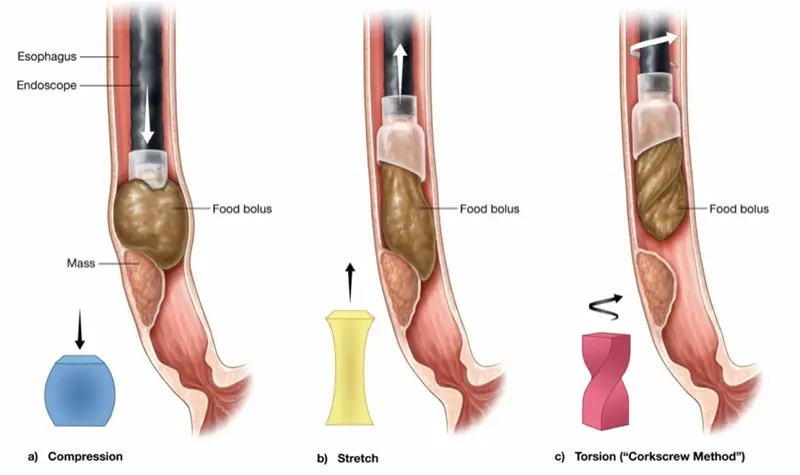
When faced with an esophageal food impaction, endoscopists traditionally have relied on push or pull techniques to dislodge the obstruction.1 Yet, just as one wouldn’t simply yank a cork from a bottle, it may be time to rethink how we approach food bolus removal. Torsional stress—twisting rather than pulling—may provide a more efficient and atraumatic method for managing these impactions, a technique we refer to as the “corkscrew method.”
The Science of Torsional Stress
Tensile (pulling) and compressive (pushing) forces act in a straight line and require substantial force to overcome friction, vacuum pressure, and tissue resistance.2 In contrast, torsional stress distributes force radially rather than longitudinally. This takes advantage of the lower shear strength of most biological materials, including impacted food boluses.3
Consider a tightly lodged cork. Pulling straight up fights friction and suction. A twisting motion breaks the seal, reduces resistance, and requires less brute force. A rotational maneuver changes the direction of applied stress and can exceed static friction without increasing direct linear force.4,5
Similarly, twisting an impacted bolus rather than forcefully pushing or pulling can gradually free it from the esophageal wall, allowing for a smoother extraction (Figure).
Practical Applications in Endoscopy
Endoscopists already use rotational maneuvers with snares, baskets, rotatable graspers, and caps. Incorporating torsional stress during food bolus removal offers several advantages. Less force is required because rotation gradually disengages the bolus, decreasing the need for strong pulling or pushing. This method also poses a lower risk for mucosal injury. Shear forces are distributed rather than focused, reducing trauma. Torsional stress also enables more controlled removal. Twisting improves maneuverability when dealing with soft, friable, or irregularly shaped boluses.
Push-and-pull methods have long been the standard technique for food bolus extraction, but adding torsional stress as a primary strategy may improve both efficiency and safety.1 As with a stubborn wine cork, sometimes a bit of rotation makes all the difference.
By adopting rotational maneuvers, we can refine food bolus extraction techniques—because no one wants to struggle with a stuck cork, whether in a bottle or in the esophagus.
References
- Ikenberry SO, Jue TL, Anderson MA, et al. Management of ingested foreign bodies and food impactions. Gastrointest Endosc. 2011;73(6):1085-1091.
- Team Xometry. Shear stress: definition, how it works, example, and advantages. Updated Dec. 16, 2025. Accessed Feb. 4, 2026. https://www.xometry.com/resources/materials/shear-stress/
- McClements D. What is torsional stress? How it works and how it is calculated. Updated Dec. 10, 2025. Accessed Feb. 2026. https://www.xometry.com/resources/materials/torsional-stress/
- SATHEE (IIT Kanpur). Physics static friction. Accessed Feb. 6, 2026. https://sathee.iitk.ac.in/article/physics/physics-static-friction/
- Roylance D. Shear and torsion. Massachusetts Institute of Technology, LibreTexts Engineering. Accessed Feb. 6, 2026. https://eng.libretexts.org/@go/page/44533
This article is from the March 2026 print issue.