






A study of nearly 1,000 patients with gastroesophageal reflux disease undergoing esophagogastroduodenoscopy found that 40% lacked proper documentation of their gastroesophageal junction anatomy, which is a strongly recommended part of any assessment for future therapeutic intervention.
“There was suboptimal reporting of [gastroesophageal] landmarks, [and] Hill grade system was only reported in 60% of cases,” said Sean Olson, DO, a third-year internal medicine resident at the University of Florida, in Gainesville. “Inadequate documentation leads to repeat procedures, additional costs, and avoidable delays in care.”
GERD is a common indication for EGD, which is necessary when determining if a patient is amenable to surgical or endoscopic fundoplication. For this, it is important that endoscopic reports contain standard and detailed notation of the gastroesophageal junction (GEJ) landmarks, but there has been significant variability in reporting practices among endoscopists, Dr. Olson said.
The study’s senior investigator, Bashar Qumseya, MD, MPH, the chief of endoscopy at the University of Florida Health, in Gainesville, elaborated. “Many endoscopists were used to paying minimal attention to the GE junction anatomy because there was very little that could be done about it, but now there are several endoscopic interventions endoscopists can offer. Thus, documenting the [GEJ] anatomy is critical for any patient with GERD symptoms.”
Recent Clinical Practice Guidelines Address a Need
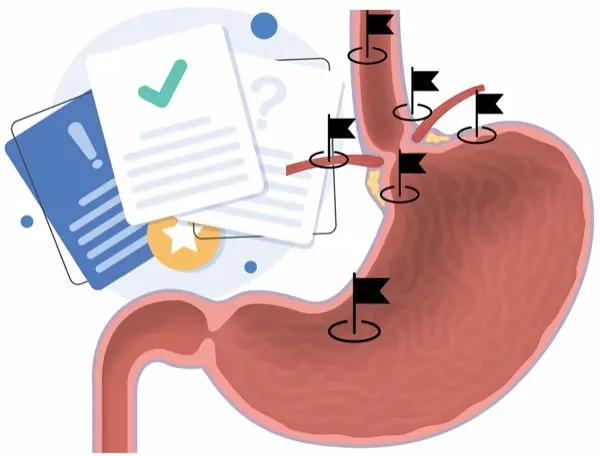
The American Society for Gastrointestinal Endoscopy (ASGE) addressed this issue in its most recent guidelines on managing GERD, said Dr. Qumseya, who was part of the guideline panel (Gastrointest Endosc 2025;101[2]:267-284). The guidelines recommend careful examination and photo documentation of the GEJ anatomy, including mention of a possible hiatal hernia using either Hill or American Foregut Society (AFS) grading. In particular, endoscopists are advised to record the following:
- Objective GERD findings, when present:
- erosive esophagitis (using the Los Angeles [LA] grading system)
- Barrett’s esophagus (by Prague classification)
- peptic stricture
- GEJ landmarks and integrity:
- hiatal hernia dimensions using Hill or AFS grading in forward view and retroflexion
- location of the top of gastric folds, Z line, and diaphragmatic impression
- existing fundoplication description (if present)
In the retrospective cohort study, Drs. Qumseya, Olsen, and their co-investigators assessed the rate of GEJ documentation among 1,000 consecutive patients referred for EGD for assessment of GERD at the University of Florida outpatient endoscopy center over a four-year period. After excluding 49 patients with a history of gastric bypass, gastropexy, esophageal malignancy, or known esophageal motility disorders, the researchers evaluated a final population of 951 patients. The study’s primary outcome was the rate of Hill grading documentation on EGD. The investigators also analyzed factors associated with GEJ landmark reporting.
Suboptimal Documentation Noted
Endoscopists documented the Hill grade in only 60% of the cases and the presence or absence of a hiatal hernia in 63%, reported Dr. Olson at DDW 2025 (abstract 948). When a hernia was noted, it was found to be present in 45% and absent in 19% of cases. The size in centimeters was noted in only 38% of cases. Endoscopists documented the locations of the Z line in 79%, the top of gastric folds in 18%, and the diaphragmatic hiatus in 33%. No endoscopists used AFS grading.
There were no significant differences in the rates of GEJ landmark location reporting according to age or body mass index. No significant association was found between the odds of Hill grade reporting and presence of visible GERD sequelae on EGD, reported epigastric pain, reported heartburn, active use of proton pump inhibitors, current tobacco use, white race, or male sex.
The odds of reporting the Hill grade were significantly lower for patients without regurgitation (P=0.002) and for patients in ASA classes III through IV (P=0.0010). Procedures in which the Hill grade was reported took about one minute longer to complete (7.3 vs. 6.2 minutes; P<0.0001).
The association between Hill grade reporting and longer exam duration and higher odds of regurgitation may have been due to a higher suspicion for dysfunction of the GEJ and, therefore, more careful inspection and documentation of those anatomic landmarks in patients, Dr. Olson suggested. The reduced likelihood of Hill grade reporting in patients in ASA classes III through IV might be explained by endoscopists performing more “narrow and focused” exams in these higher-risk patients “and their perceived candidacy for fundoplication,” he said.
“These data support previous studies that show the significant amount of variability in adequate documentation practices in endoscopy reports and the lack of detailed notation on these reports,” Dr. Qumseya added. “They also show how patients who are undergoing evaluation for anti-reflux surgery or endoscopy are subjected to repeat endoscopy, which confers a low but measurable risk for additional sedation, superfluous cost, and, ultimately, a delay in their care.”
The study team acknowledged that a limitation of the study is that it was conducted before the new ASGE guidelines, which may have since reduced endoscopists’ variability and boosted documentation.
Additional Tips From an Expert
Harish K. Gagneja, MD, the vice chair of the American College of Gastroenterology Board of Governors and a member of the Physician Executive Board of GI Alliance, said he was not surprised by the study’s findings. In fact, he said he was “positively impressed” that 60% reported Hill grade. “In my experience, very few gastroenterologists report Hill grade classification as compared to foregut surgeons,” he offered.
Dr. Gagneja reiterated that proper documentation of GEJ findings should include the location of the GEJ, location of hiatal impingement, Prague classification in the presence of Barrett’s esophagus, Hill grade in the presence or absence of hiatal hernia, and LA classification for severity of erosive reflux disease. “This is of paramount importance to properly manage a patient and plan future treatment options,” he emphasized.
“One other issue I see is improper maintenance of scopes, leading to not-so-clean/robust retroflexion and, hence, not being able to properly document Hill grade, as it is important to look at the cardia,” he added. “In selected cases, when examination of the [GEJ] is difficult, a distal clear cap can help with proper documentation of landmarks.”
—Caroline Helwick
Dr. Gagneja reported no relevant financial disclosures. He is a member of the Gastroenterology & Endoscopy News editorial board. Dr. Olson reported no relevant financial disclosures. Dr. Qumseya reported financial relationships with Boston Scientific, Fujifilm, and Medtronic.

This article is from the December 2025 print issue.