





| Section Editors | |||||
|---|---|---|---|---|---|
Affiliate Professor of Medicine University of Washington School of Medicine Seattle, Washington | Professor of Medicine Virginia Tech Carilion School of Medicine Roanoke, Virginia Universidad de La Rep=blica Montevideo, Uruguay | ||||
| Contributors | |||||
Josip Juraj Strossmayer Universität Osijek Osijek, Croatia Ameos Klinikum Halberstadt, Germany | Berufsfachschule für Pflege, Helios Frankenwaldklinik Kronach, Germany | Professor of Medicine Virginia Tech Carilion School of Medicine Roanoke, Virginia Universidad de La Rep=blica Montevideo, Uruguay | |||
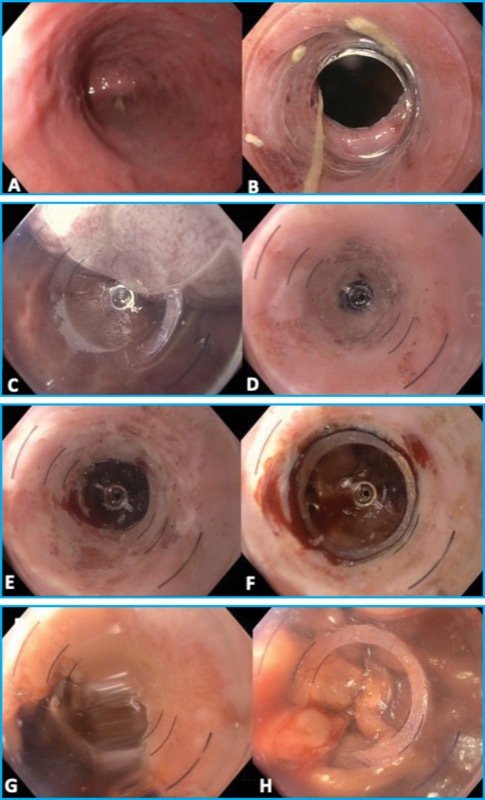
An older adult man presented with recurrent meat boluses, and examination revealed a tight, fibrotic Schatzki ring (Figure 1, panels A, B). Destruction of Schatzki rings can be accomplished with dilation using Savary or Maloney bougies, balloon dilation, star-like incisions, circumferential excision using an IT knife, cold biopsy mini-excisions, or with the novel, single-use, disposable BougieCap (Ovesco). In this case, we elected to use the BougieCap for several reasons: The cap is transparent (Figure 1, panels C-G) and has 3 dilating sizes, which are marked on the cap (Figure 1, panels C-F), and the entire dilation (bougienage) procedure can be observed through the cap, in contrast to Savary or Maloney dilations (Figure 1, panels D-G). Also, because many countries have embraced a throwaway approach to utensils (one-time use, disposable devices, including Savary dilators), selecting the cheapest and equally or most effective device makes sense.
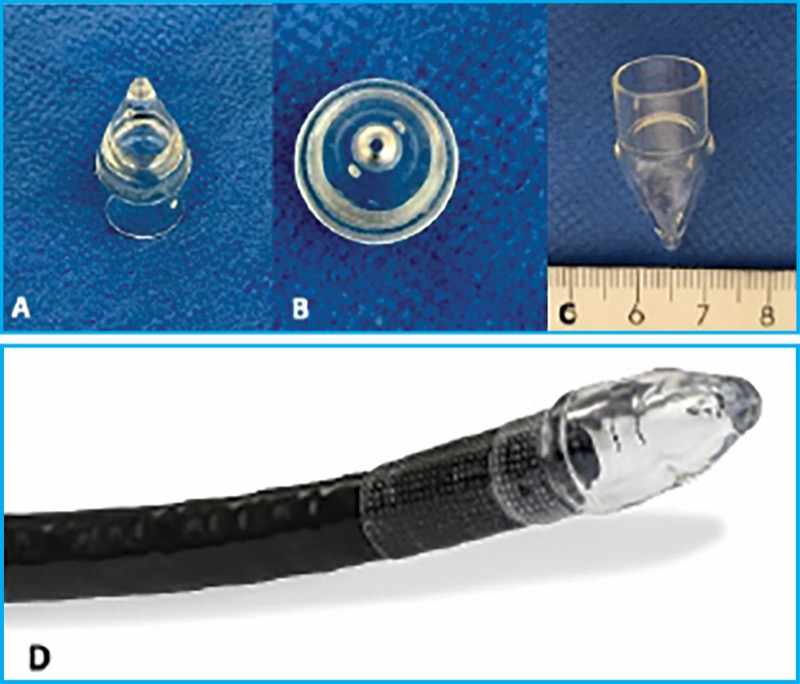
This distally transparent, conically shaped cap is attached to the distal scope, making the scope a “bougie dilator” (Figure 2). The BougieCap is available in various sizes, each with 2 different dilation diameters, allowing gentle stricture dilation and potentially minimizing the risk for complications.
The conical BougieCap is attached distally to the endoscope with special tape and advanced to the stenosis. By pushing forward and gently rotating the endoscope, the endoscopist can dilate the mucosal stricture (Figure 1, panel E). The BougieCap includes a front aperture for advancing a 0.021- to 0.035-inch (biliary) guide wire (maximum 1 mm) when required, and 2 lateral apertures that permit air insufflation, water irrigation, and suction (Figure 2).
Direct visual control during endoscopy is enabled by the transparent plastic material of the BougieCap. In addition, vessel compression by the BougieCap enhances mucosal examination, which improves the visibility of mucosal tears and reduces the risk for mucosal bleeding.
The single-use BougieCap is especially advantageous in the context of green endoscopy initiatives because it reduces plastic waste by up to 99% compared with traditional dilation techniques. Moreover, the cap is much less expensive than disposable balloons and Savary dilators.

Do you have your own tips and tricks in endoscopy?
to share, send them to smtilyou@mcmahonmed.com, and we will consider them for a future installment of EndoHacks.
Nonetheless, Savary bougies and dilation balloons are safe and efficient techniques that have been available for more than 5 decades. Thus, prospective studies evaluating the novel BougieCap with other dilation methods are warranted.
Dr. Mergener is a member of the Gastroenterology & Endoscopy News editorial board.
See endocollab.com for more information, including videos, quick tips, and lectures on these and many other practical endoscopy tricks and techniques.
This article is from the July 2025 print issue.