






In a large, pragmatic quality improvement program, investigators from the Department of Veterans Affairs showed that the availability of computer-aided detection systems improved adenoma detection rates over those seen at sites where CADe was not provided, although it did not affect all quality colonoscopy indicators.
“The odds of adenoma detection improved by 22%. Significant improvements in ADR persisted compared to sites without CADe,” said Jason A. Dominitz, MD, the executive director of the Veterans Health Administration’s National Gastroenterology and Hepatology Program, and a professor of medicine at the University of Washington, in Seattle.
However, the researchers also observed a long-term trend toward a slight decline in ADR at sites offering CADe. Dr. Dominitz suggested this trend might reflect a reduction in the actual use of CADe, although this could not be determined based on the study design.
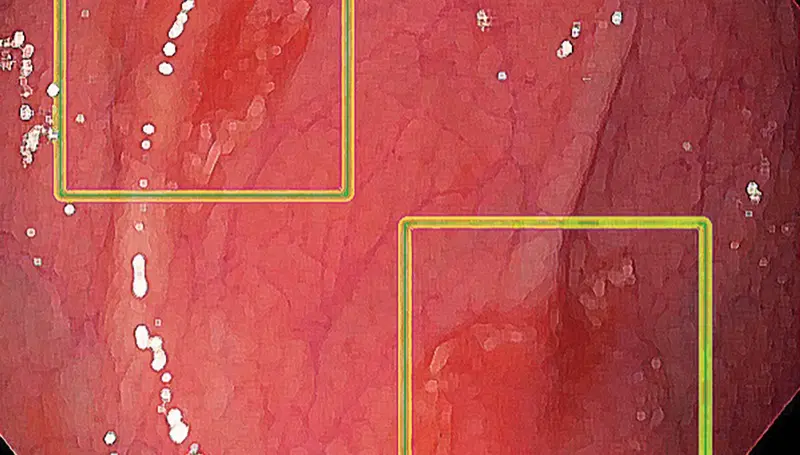
At DDW 2025, Dr. Dominitz presented the first findings of the CADeNCE study, which assessed the durability of the impact of CADe on colonoscopy quality indicators in a real-world setting of a large national healthcare system (abstract 364). In the study, the researchers installed 115 CADe devices (GI Genius, Medtronic) at 42 randomly selected VA facilities between October 2022 and February 2023. Control facilities were randomly assigned an implementation date during that time frame. VA facilities were stratified into one of three groups according to mean ADR (<30%, 30% to <40%, and =40%), and CADe devices were randomly sorted among these strata.
Outcomes were assessed during three time periods: pre-implementation (Oct. 1, 2021, to Feb. 17, 2023); post-implementation (from implementation to June 30, 2023); and follow-up (July 1 to Dec. 31, 2023).
Control sites were censored on the date of installation of CADe devices. Investigators controlled for pre-randomization ADR stratum and patient and endoscopist demographics. A total of 245 endoscopists in the CADe arm and 485 in the control arm contributed at least one colonoscopy in each study phase.
To estimate the effect on ADR, providers were divided into quintiles based on their pre-implementation ADR. The researchers performed a quintile analysis using only providers who had 100 or more procedures in each of the three study phases: a total of 98 CADe and 170 control providers.
CADe Availability Improved ADRs
CADe availability was associated with a significant increase in ADR from pre- to post-implementation (odds ratio [OR], 1.22; P<0.0001) and from pre-implementation to follow-up (OR, 1.16; P<0.0001) compared with control sites. There was a nonsignificant decrease in the association between CADe and ADR between post-implementation and follow-up (OR, 0.95; P=0.06), he reported.
“Over the next six months, ADR still significantly increased compared to pre-implementation, though not quite as much. There was a durable effect,” Dr. Dominitz told Gastroenterology & Endoscopy News.
Based on anecdotal reports from some VA facilities, Dr. Dominitz speculated that some of this small “fall-off” in effect may be related to decisions to avoid use of CADe with new GI fellows starting on July 1, right at the start of follow-up. The study was unable to directly measure CADe use with each procedure.
In the quintile analysis, ADRs for physicians at the control sites remained generally stable, although in the highest-performing control group, the mean ADR fell from 66% to 61% by follow-up in an example of regression to the mean, he pointed out.
At the CADe sites, all quintiles improved. In the post-implementation phase, the lowest quintile improved from 38% to 45% and the highest jumped from 65% to 69%. As seen in the primary outcome measure, a small decline in ADRs in the follow-up phase was seen across all quintiles of the CADe group, he reported.
No important differences were observed in terms of other colonoscopy outcomes, but sites with CADe reported that median withdrawal time was approximately one minute longer pre-implementation, which did not significantly change after implementation of CADe. The detection of sessile serrated lesions and adenocarcinomas was not improved by the availability of CADe.
Unknowns and Study Limitations
Dr. Dominitz addressed one of the study’s important limitations: whether CADe was actually used. “The question was what happens if you deploy CADe in an endoscopy unit—not what happens if a doctor uses it in every case. The use was at the discretion of the endoscopist,” he said. “So we are unable to measure whether the slight decline in ADR that bordered on statistical significance could reflect dgecreased utilization of CADe over time.”
Other reasons for the decline could include “alert fatigue” and avoidance of its use by new trainees (e.g., the July 1 arrivals). Finally, the researchers were unable to determine the number of adenomas removed per colonoscopy, the size of the adenomas, the number of pathology specimens obtained, and the indication for colonoscopy, he noted.
“This large, real-world VA study shows that CADe can deliver lasting improvements in adenoma detection, supporting its role as a true quality improvement tool rather than just a research finding,” said session co-moderator Sravanthi Parasa, MD, a gastroenterologist at Swedish Health Services, in Seattle.
“Durability is essential when evaluating AI, since short-lived benefits may not meaningfully impact patient outcomes or systemwide care,” she added. “By demonstrating sustained ADR gains, this work highlights CADe’s potential to standardize colonoscopy quality, reduce variability among endoscopists, and guide future research on human–AI interaction and training so that AI becomes a long-term driver of consistent, high-quality colorectal cancer prevention.”
—Caroline Helwick
Drs. Dominitz and Parasa reported no relevant financial disclosures.



This article is from the December 2025 print issue.