





Use of automated multiple air flow was significantly more effective than the conventional method for drying endoscopes during reprocessing, according to data from a new proof-of-concept study.
Automated drying devices (ADs) using multiple air flows have shown potential for more thorough drying of endoscopes compared with the standard drying method using an endoscope washer-disinfector (EWD), but data are limited, the researchers said. Drying is a critical component of high-level disinfection, and when it is incomplete, it can open the door for contamination, according to Florian A. Michael, MD, of Goethe University, in Frankfurt, Germany, and his co-investigators (Am J Gastroenterol 2025;120[5]:1027-1035).
The researchers randomized 60 endoscopes—including duodenoscopes, colonoscopes and gastroscopes from three different manufacturers—to standard drying or the novel drying method, which involved the use of an AD manufactured by Pentax with a combination of laminar and turbulent air flows.
After being used on patients, the endoscopes were cleaned in accordance with current guidelines, then randomized to one of the drying methods and stored in a cabinet for 14 days (n=30 for both groups).
The researchers measured residual fluid in the channels immediately after the drying process and bacterial contamination after 14 days of storage. None of the endoscopes dried with the AD (0%) had residual water in the endoscope channels, whereas 90% of those dried with the standard method retained moisture. After 14 days, significantly fewer endoscopes in the AD group than in the standard drying group showed evidence of bacterial contamination (20% vs. 47%; P=0.028). Median drying time for the AD group also was significantly shorter than for the standard drying group (16:04 vs. 5:59; P<0.001).

The clinical results of most available drying methods are not satisfactory because they are either insufficient or time-consuming, Dr. Michael told Gastroenterology & Endoscopy News. “Insufficient drying leaves residual fluid in endoscope channels,” he said, adding that a moisture-rich environment might foster residual bacterial and subsequent biofilm development within the endoscope channels that is difficult to remove.
“Our trial showed that all endoscopes in the group dried by a new automatic drying device were entirely dry, but almost all endoscopes dried by the drying program of an endoscope-washer disinfector [EWD] remained wet,” he said. Although previous data have suggested that EWD drying programs are inefficient, the extent of the persistent wetness was a concerning and unexpected finding, he said.
The reason for the superiority of the AD over the standard drying program may be due to its novel approach, Dr. Michael said. Currently available drying methods are based solely on laminar airflow, but the AD uses a combination of laminar and turbulent airflow, he explained.
Of note, “all endoscopes were stored for 14 days in both study groups, but only a single endoscope in the EWD arm was not fit to use, despite the persistence of wetness, according to current guidelines definitions of more than 20 [colony-forming units] per channel,” Dr. Michael said. International standards for the storage period vary, but data from the current study suggest that a 14-day storage period is safe, he said.
Related Content
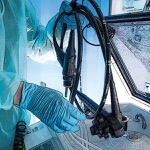
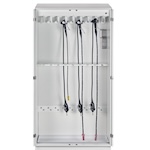
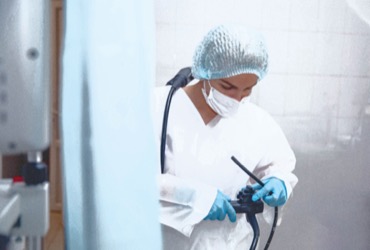
The new drying device had the fastest published operational time of all published drying methods, with a mean runtime of about six minutes, which means expanded use could improve the overall efficiency of the reprocessing cycle, Dr. Michael noted.
Study limitations include lack of blinding of the device operator, although all other parties participating in the trial were blinded, he said, adding that another trial with an accurate sample size calculation is needed to support the outcomes.
“The more completely you can dry the endoscope, the less likely it is to be recontaminated during storage,” noted V. Raman Muthusamy, MD, MAS, a gastroenterologist at the University of California, Los Angeles, who co-authored a 2020 article on this topic (Gastrointest Endosc Clin N Am 2020;30[4]:665-675).
This study has the potential to affect clinical practice by improving the quality and efficiency of scope reprocessing, Dr. Muthusamy said.
He told Gastroenterology & Endoscopy News he was surprised by the high rates of contamination reported 14 days after reprocessing but noted that the study authors were strict in their definitions. Although 20% is suboptimal, one could argue that 80% of the scopes treated with the new drying method had not a single bacterium after two weeks, he said.
If the study findings can be validated in a broader array of scopes, it could affect clinical practice by supporting the use of standard cabinet storage after cleaning, rather than the current common use of specialized drying cabinets, which could result in space and cost savings, Dr. Muthusamy said. In addition, he said, validation of the current study findings in larger studies might allow for an increase in the interval of time before unused scopes need to be reprocessed.
—Heidi Splete
The study was supported by Pentax. Dr. Michael reported a financial relationship with Chemische Fabrik Dr. Weigert and Pentax. Dr. Muthusamy reported a previous consultantship with Pentax unrelated to the current study.
This article is from the October 2025 print issue.