





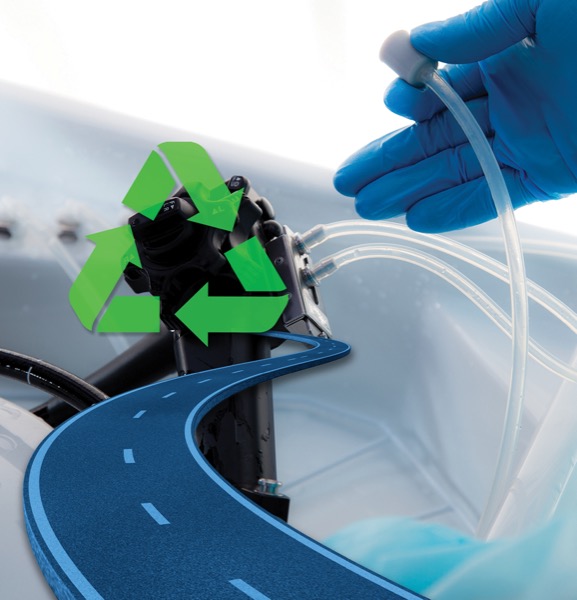
PHILADELPHIA—A structured recycling initiative in a high-volume gastrointestinal endoscopy center cut greenhouse gas emissions by more than 3 metric tons and reduced procedural costs by nearly 29%, according to data presented at ACG 2024. The research may provide a framework for other endoscopy centers working to reduce their effect on the environment.
To determine the best ways to recycle, gastroenterologists and facilities “need to work with manufacturers” and develop plans for “how green endoscopy is going to look in the future,” said Immanuel Ho, MD, the director of interventional endoscopy at Pennsylvania Hospital, in Philadelphia, and a clinical professor at the University of Pennsylvania who led the research. This study moves the field in that direction, providing “a blueprint for integrating recycling practices in GI endoscopy [and] demonstrating that sustainable practices can significantly reduce the carbon footprint associated with healthcare activities,” Dr. Ho said.
Dr. Ho initiated the study after learning that Boston Scientific already was running a rudimentary recycling program. He proposed that his team at the University of Pennsylvania and Penn Medicine would work with Boston Scientific on an endoscopy recycling program and collect data the company could use to improve its own recycling program.
“Medical plastic is very complex. Nobody knows where to put it,” said Swapna Gayam, MD, an associate professor of gastroenterology and hepatology at the West Virginia University School of Medicine, in Morgantown, who was not involved with the research. “We definitely need industry to take the lead on this. I don’t think clinics can do it on their own.”
Healthcare Is a Huge Source of Waste
Dr. Gayam said of the three major ways to address waste—reduce, reuse and recycle—decreasing the amount of materials healthcare facilities are using is the most important but, unfortunately, not always possible because reusing materials is difficult in a medical setting.
“It’s important to recycle as much as we can because that often is the only thing we can do to eliminate at least some of the plastic going into landfills,” she said, adding that specialized recycling programs for endoscopy waste would be particularly helpful for hospitals in areas without access to any type of recycling.
Related Content
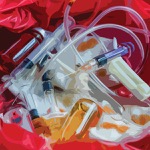
In GI endoscopy, there’s much room for improvement. A 2023 systematic review estimated that there are more than 18 million GI endoscopy procedures performed in the United States every year, with each procedure generating as much as 3 kg of waste. While most of this waste is not recyclable, according to the review, about 20% of the waste that ends up in landfills can be recycled (Gut 2023;72[3]:493-500).
In the University of Pennsylvania study, which earned an ACG Outstanding Research Award (abstract 32), Dr. Ho and his co-investigators evaluated 3,063 endoscopy procedures conducted between Jan. 15 and June 15, 2024. The investigators placed a canister for recyclables in each of the hospital’s three endoscopy rooms and trained all technicians to recognize which items could go in the canisters. This included gauze, certain valves, air/water cleaning keys and suction tubing. Representatives from Boston Scientific helped identify what materials could be recycled. At the end of each day, the contents of the canisters were packaged into boxes to be shipped to Sharps Medical Waste Services, in Texas, where 99% of the materials eventually were recycled.
Over the course of six months, the hospital was able to recycle more than 1,708 kg of waste and avoided more than 3 metric tons of carbon dioxide emissions—the equivalent of driving about 9,000 miles, or about half the energy an average home uses per year, according to the Environmental Protection Agency’s Greenhouse Gas Equivalencies Calculator.
“Recycling is definitely feasible in a high-volume [advanced endoscopy center] and requires, in our experience, no additional time expended during each procedure,” Dr. Ho said during his presentation, noting that it did require extra staff time to collect, box and ship the recyclables.
A major strength of this study was its emphasis on integrating recycling with minimal disruption to daily operations, he added, as each procedure used a single endoscopy kit, which was then recycled in its entirety.
A secondary benefit of the recycling initiative was a slight reduction in red bag waste—the regulated medical waste that is costly to dispose of and cannot be recycled. Although the decrease from 28.2 to 27.1 kg per day was not statistically significant, Dr. Ho said, it reflects a gradual shift in waste disposal practices and offers potential cost savings as green initiatives in endoscopy continue to gain traction.
Challenges of Widespread Implementation
The study showed significant waste reduction, but Dr. Ho said the system is not perfect. There is a carbon footprint associated with shipping—about 1,708 kg of carbon dioxide over the six-month period—and recycling is not free. Although the University of Pennsylvania realized a cost savings of nearly 30% per case, “there is still a cost that is associated with recycling, and in our study, the cost was borne by the manufacturer,” Dr. Ho said.
Frequent waste removal is essential, he added, noting that daily pickups could better serve high-volume centers. In addition, the initiative required ongoing staff support to manage and track recyclable materials, which may pose a resource constraint for some facilities.
It’s not yet clear who would be responsible for absorbing any extra costs in the future, whether that be providers, the government or manufacturers. With an estimated cost of $160,000 over six months, Dr. Ho said the expense of maintaining a comprehensive recycling program may be prohibitive for some centers, particularly without external funding or subsidies.
“Recycling offers a practical solution for reducing the carbon impact of GI endoscopy without compromising workflow, but expanding this model will require coordinated support from healthcare systems, industry stakeholders and policymakers,” he said. Nevertheless, “as a proof-of-concept study, we showed that recycling can be done.”
Mark B. Pochapin, MD, the director of the Division of Gastroenterology and Hepatology at NYU Langone Health, in New York City, commended the study, highlighting that “it addresses something that seems so obvious, and it’s great to finally see data on it. You can literally drive around the world with the amount of savings.”
However, Dr. Pochapin also raised concerns about the potential danger of recycling tubing contaminated with infectious material, asking whether the tubing selected had been kept clear of exposure to organic waste.
Dr. Ho clarified that the tubing used was generally not heavily contaminated and said the study received approval from infectious disease authorities to proceed.
—Kaitlin Sullivan and Chase Doyle
Dr. Ho reported financial relationships with Merck and Novartis. Dr. Pochapin reported no relevant financial disclosures.
This article is from the December 2024 Priority Report print issue.